Keyword Density: How To Avoid Keyword Stuffing

Keyword stuffing is the excessive or unnatural repetition of search terms on a webpage in an attempt to influence its search rankings. Ot is a black-hat SEO tactic. It can make content difficult to read and may breach Google’s spam policies when keywords are used to manipulate search results.
The tactic was more common when search engines relied heavily on exact keyword matches. Today, search engines are much better at understanding language, context and the overall subject of a page. Content should therefore answer the reader’s question clearly rather than repeat the same phrase as often as possible.
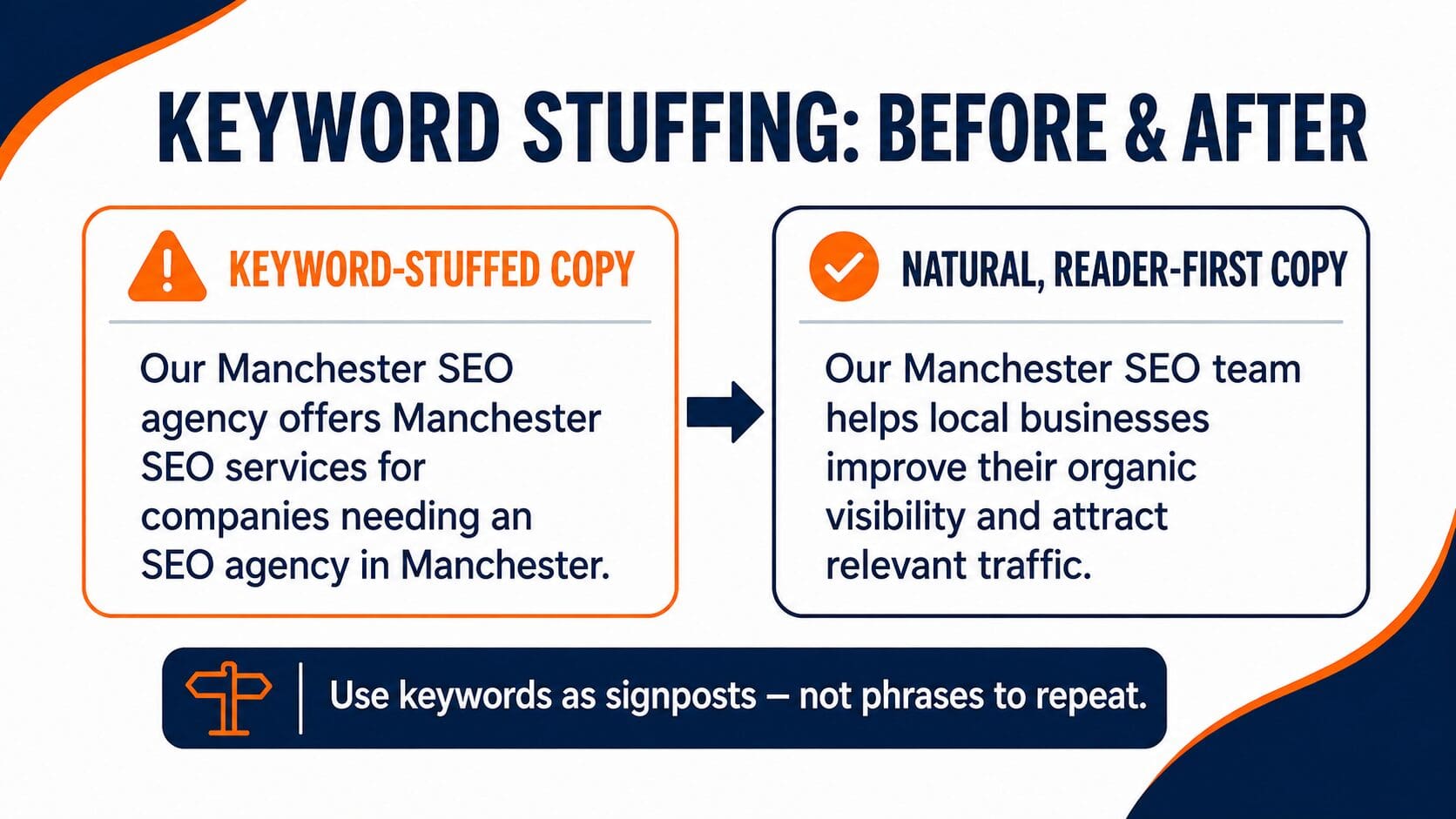
Google now praises natural language, with content judged on how helpful it is to users, rather than high keyword density. This was a common feature on websites trying to rank for localised terms, with their city repeated at the end of every keyword or phrase – completely unnaturally.
Even if the keywords you use are different each time, this old-school tactic can harm your SEO efforts, as well as put readers off due to the poor writing style.
Google lists keyword stuffing in its spam policies. Examples include repeating the same words until the copy sounds unnatural and adding blocks of cities or regions that a page is attempting to rank for.
Overusing keywords can also affect performance in several indirect ways:
Poor readability: Repetitive language makes content difficult and tiring to read.
Reduced trust: Forced wording can make a business appear less credible.
Lower engagement: Visitors may leave if the page does not answer their question clearly.
Fewer conversions: Awkward copy can distract people from the service, product or next step.
Reduced search visibility: Content that breaches Google’s spam policies may rank lower or be removed from search results.
Google encourages website owners to produce helpful, reliable, people-first content. Its quality guidance also considers Experience, Expertise, Authoritativeness and Trustworthiness, commonly referred to as E-E-A-T.
Instead of writing to satisfy a keyword counter, demonstrate genuine knowledge, answer the reader’s questions and provide information they can trust.
Overusing keywords can appear in more than just the main page, body or blog; keywords can also be overused in several important on-page elements. Some of these include:
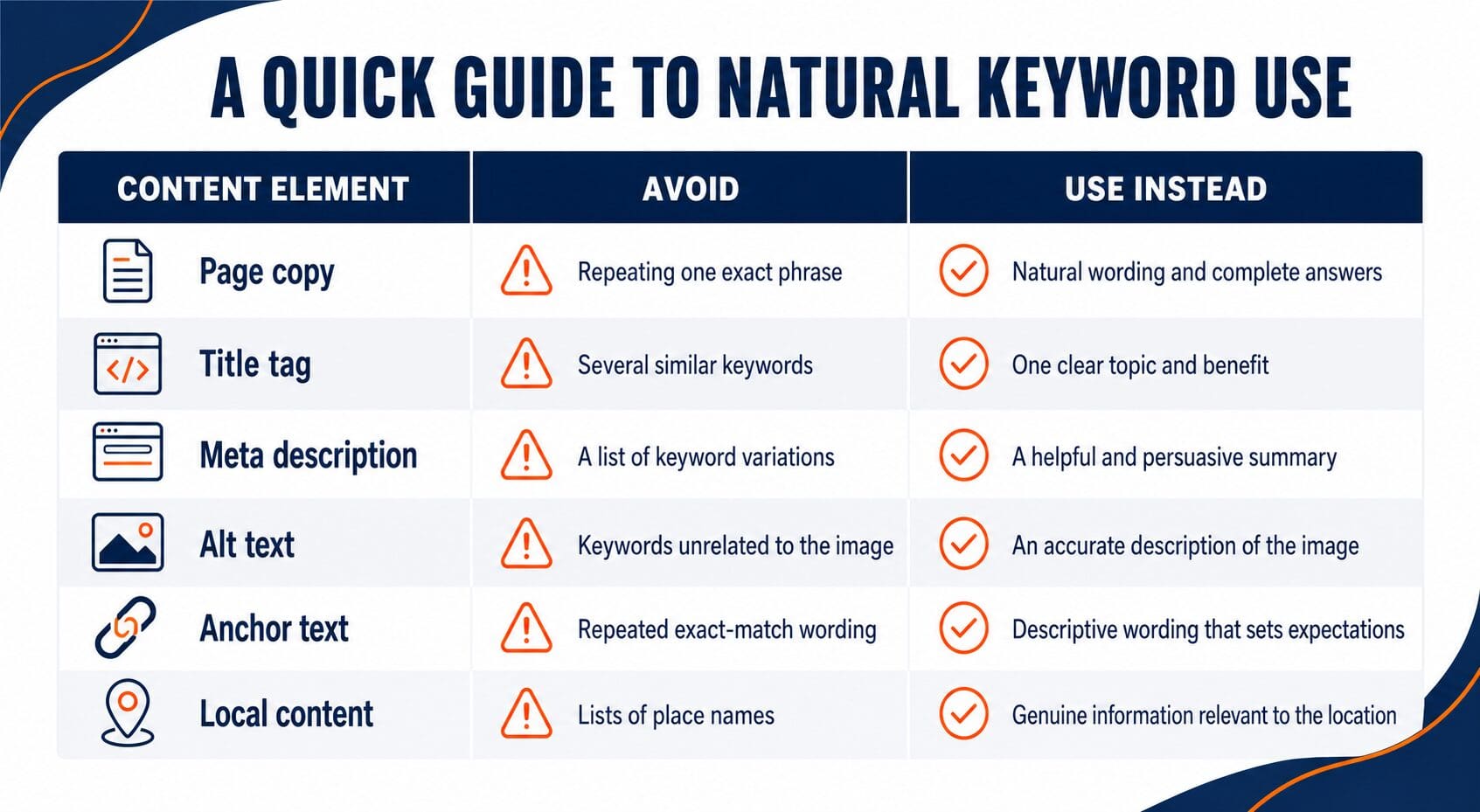
Title Tags: Title tags are the clickable headlines that show up in search results. Keyword stuffing happens when too many similar keywords are crammed into the title, making it look unnatural and less likely to get clicks.
An example of this is:
Keyword-stuffed title:
SEO Agency Manchester | Manchester SEO Company | SEO Services Manchester
Improved title:
SEO Agency in Manchester | Clever Clicks Digital
Meta Descriptions: A meta description is a summary under the title in search results. If too many keywords are packed into it, the description becomes hard to read and less likely to attract visitors.
Alt Texts: Alt texts describe images for people who can’t see them, like visually impaired users. Stuffing these descriptions with keywords instead of focusing on what the image actually is can hurt both accessibility and SEO.
Anchor Texts: Anchor texts are the clickable text links on a page. When keywords are overused in these links, it can make the text look spammy and lead to lower rankings by search engines.
When it comes to keyword stuffing, there can be many ways to avoid it, so here are some of them:
1) Use your words organically: when you are writing your content, make sure it is written in your own words and tone of voice to reflect your branding and company. This can help to avoid your writing coming across as robotic, spammy and stuffed. Begin with the question or problem the reader wants to solve; you must write for the reader first. Reading the content aloud is a useful test; if the sentence sounds forced or repetitive when spoken, it will probably feel unnatural to the reader too.
2) Diversify the keyword: Avoid repeating the same keyword throughout the article. Use natural variations, synonyms and related phrases where they improve the reader’s understanding.
For example, an article targeting “cheap coats” might also refer to affordable jackets, budget-friendly outerwear or reasonably priced winter clothing. These alternatives should make sense in context rather than being inserted purely for SEO.
3) Monitor keyword density: Keyword density measures how frequently a keyword appears in relation to the total number of words on a page. It can help you spot excessive repetition, but it should be treated as a diagnostic rather than a target.
There is no universal keyword-density percentage that guarantees higher rankings. Instead of aiming for a strict figure such as 1–2%, check whether the copy reads naturally and whether every keyword mention serves a clear purpose.
4) Choose your metadata carefully: Your title and meta description should accurately explain what the page is about and encourage the right audience to click. Avoid filling them with several variations of the same keyword.
Include the main topic where it fits naturally, then focus on clarity, relevance and the benefit to the reader. A concise, informative title is usually more persuasive than a list of search terms.
5) Prioritise the reader: Keep the reader’s question, needs and level of knowledge at the centre of the article. Avoid adding buzzwords or repeated search phrases when they make the content difficult to understand.
Useful content should provide clear answers, practical guidance and an easy next step. If a passage exists only to include another keyword, it probably needs to be rewritten or removed.
6) Use related terms and topics: Search engines can understand the broader context of a page, so you do not need to rely on outdated ideas such as “LSI keywords.” Instead, cover relevant terms, entities, questions and subtopics that help explain the subject thoroughly.
For an article about keyword stuffing, related topics might include keyword density, search intent, content quality, alt text, anchor text and Google’s spam policies. Only include them when they add genuine value to the article.
7) Expand your content where it adds value: Longer content is not automatically better, and extra words should not be added simply to reduce keyword density. Expand a section only when the additional information helps the reader.
You could add a practical example, an expert observation, a checklist, supporting evidence or an answer to a related question. Every new section should contribute something useful rather than repeat an earlier point.
8) Write alt texts properly:
Alt text should accurately communicate the content or purpose of an image, particularly for people using screen readers. It should not be treated as another opportunity to insert keywords.
Keep descriptions concise and relevant to the image. If a keyword naturally helps describe what is shown, it can be included, but accessibility and accuracy should always come first.
In summary, refraining from keyword stuffing is essential to preserving the quality of your content and your search engine ranking. Although it could seem alluring to stuff your content with keywords in an attempt to boost search engine results, doing so will make you less visible to readers.
Making natural, reader-friendly material a priority and properly employing the right words will guarantee that your content flows naturally and benefits your readers.
You can efficiently optimise your content without using stuffing by striking a balance between keyword density and diversity in your wording, trying different phrase structures, and emphasising well-written, interesting material.
If you’re looking for assistance with SEO, copywriting or content creation, feel free to get in touch with our team.
Did you find this blog interesting? Learn more about how to create a focused keyword strategy in our blog: How To Identify Low-Hanging Fruit Keywords

How AI Is Changing Digital Marketing in the UK (And What to Do About It in 2026)
Read full blog
5 Things That Make Visitors Bounce from Your Website Instantly
Read full blog