How AI Is Changing Digital Marketing in the UK
What to Do About It in 2026


In 2026, digital marketing in the UK is undergoing one of the most significant transformations the industry has ever experienced. Artificial Intelligence (AI), once viewed as an emerging or experimental technology, has now become a foundational part of how marketing strategies are planned, executed, measured, and refined across virtually every sector. For UK businesses, agencies, and in-house teams alike, it is now actively shaping competitive advantage in real time.
However, while AI promises efficiency, scalability, and sharper insights, it also introduces new complexities around skills, ethics, regulation, and long-term strategy. Understanding how AI is changing digital marketing and knowing how to respond is now essential for any UK business that wants to remain visible, relevant, and profitable in 2026 and beyond.
AI adoption within UK marketing teams has accelerated rapidly over the last few years, driven by the increasing availability of AI-powered platforms and growing pressure to do more with limited budgets. According to Salesforce’s State of Marketing report, 73% of UK marketers are already using AI tools in their day-to-day roles, highlighting how quickly artificial intelligence has moved from experimentation to standard practice.
This widespread adoption reflects a clear shift in mindset. AI is no longer viewed as a specialist or technical tool reserved for large enterprises; instead, it is being used by small and medium-sized UK businesses to support content creation, campaign optimisation, customer targeting, and performance reporting. In many cases, AI is already embedded within commonly used platforms such as paid advertising systems, CRM software, and analytics tools, meaning businesses may be using AI without even realising it.
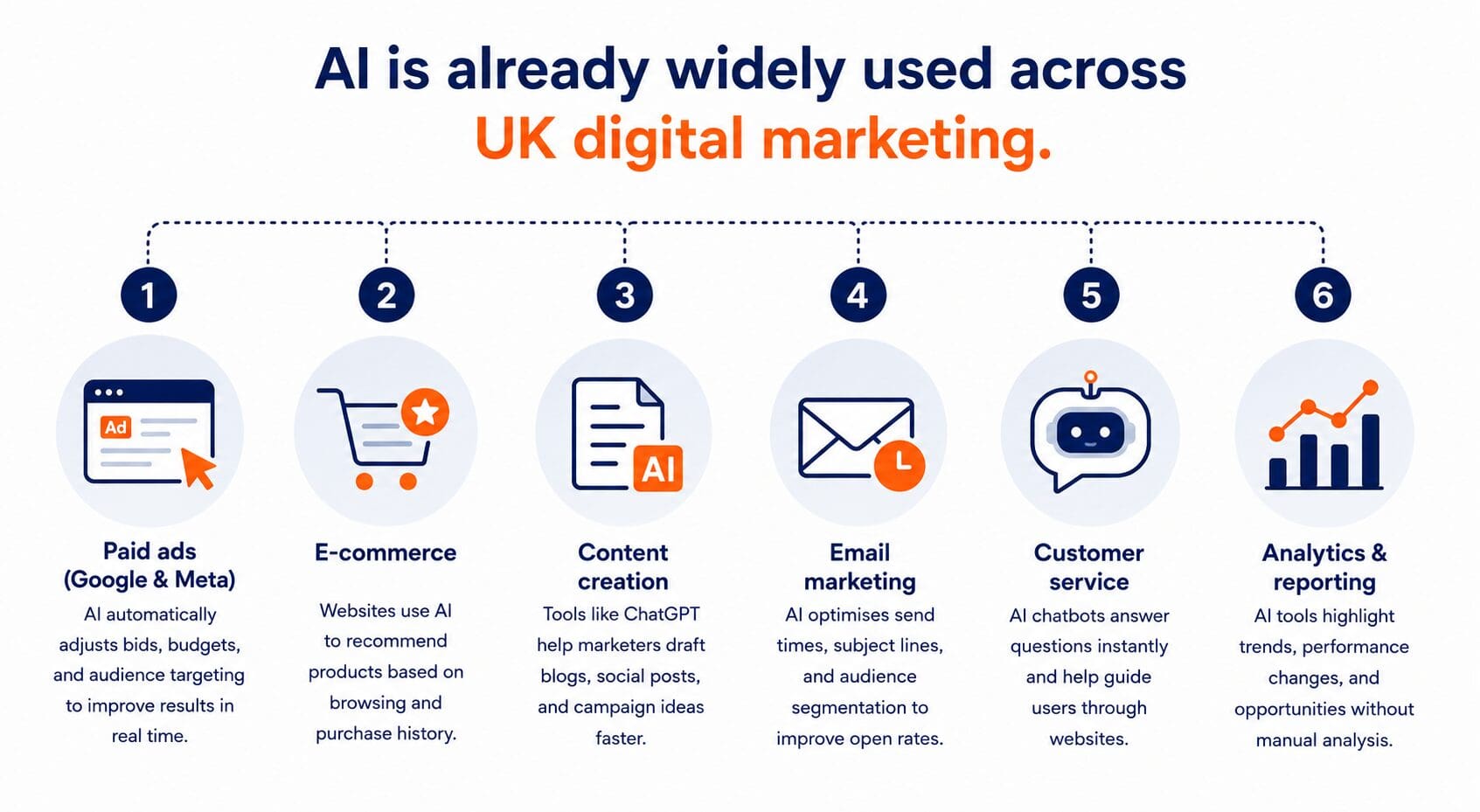
AI is already widely used across UK digital marketing. Here are some simple, real-world examples:
One of the most visible ways AI is changing digital marketing in the UK is through its impact on personalisation and audience targeting. Traditional segmentation models, which relied heavily on basic demographics or static audience lists, are being replaced by AI-driven systems that analyse real-time user behaviour, intent signals, and engagement patterns across multiple channels.
AI allows UK marketers to move beyond generic messaging and deliver highly relevant content that reflects where a user is in their decision-making journey. This means that website visitors, email subscribers, and ad audiences are increasingly seeing tailored messages, offers, and recommendations based on predictive insights rather than assumptions.
As customer expectations for relevance continue to rise, particularly in competitive UK markets, this level of personalisation is quickly becoming a baseline requirement rather than a differentiator. In fact, McKinsey research shows that 80% of consumers are more likely to purchase from brands that offer personalised experiences, reinforcing why AI-driven targeting is becoming essential in competitive UK markets.
AI has also become a powerful driver of efficiency across digital marketing operations, allowing teams to automate time-consuming tasks that previously required significant manual input. From scheduling campaigns to adjusting bids, analysing performance data, and responding to customer enquiries, AI-driven automation is enabling marketers to scale activity without proportionally increasing costs.
For UK businesses facing ongoing economic uncertainty and pressure on marketing budgets, this efficiency is particularly valuable. AI tools can optimise campaigns in real time, identify underperforming activity faster, and reduce wasted spend, all while freeing up marketers to focus on higher-value strategic planning and creative development.
HubSpot’s State of Marketing Report found that marketers using AI save over 2 hours per day on repetitive tasks such as reporting, scheduling, and content creation, freeing up time for more strategic activity. Rather than replacing marketing roles, AI is reshaping them, shifting the emphasis away from repetitive tasks and towards insight-led decision-making.
Data has always been central to effective digital marketing, but AI has fundamentally changed how that data is interpreted and applied. Instead of relying solely on historical performance reports, UK marketers can now use AI-driven analytics to predict future outcomes and make proactive adjustments.
Predictive analytics allows businesses to forecast which leads are most likely to convert, identify customers at risk of disengaging, and allocate budget more effectively across channels such as SEO, PPC, and paid social. This predictive capability is particularly important as digital marketing channels become more competitive and margins tighter.
In 2026, success in UK digital marketing will increasingly depend on a business’s ability to interpret complex data quickly and act on it with confidence.
Content marketing remains a cornerstone of digital marketing strategy, and AI is playing an increasingly prominent role in how content is produced and optimised. Generative AI tools are now widely used to support blog writing, social media captions, ad copy, video scripts, and content repurposing, allowing teams to maintain consistency and output at scale. HubSpot also reports that 58% of marketers say AI helps them significantly speed up content creation, particularly for ideation, drafting, and repurposing content across channels.
Importantly, AI works best as a support system rather than a replacement for human creativity. While AI can generate structure, suggestions, and drafts, it is human insight that ensures content reflects brand voice, strategic intent, and real-world experience. For UK businesses looking to stand out in saturated markets, maintaining this balance is critical.
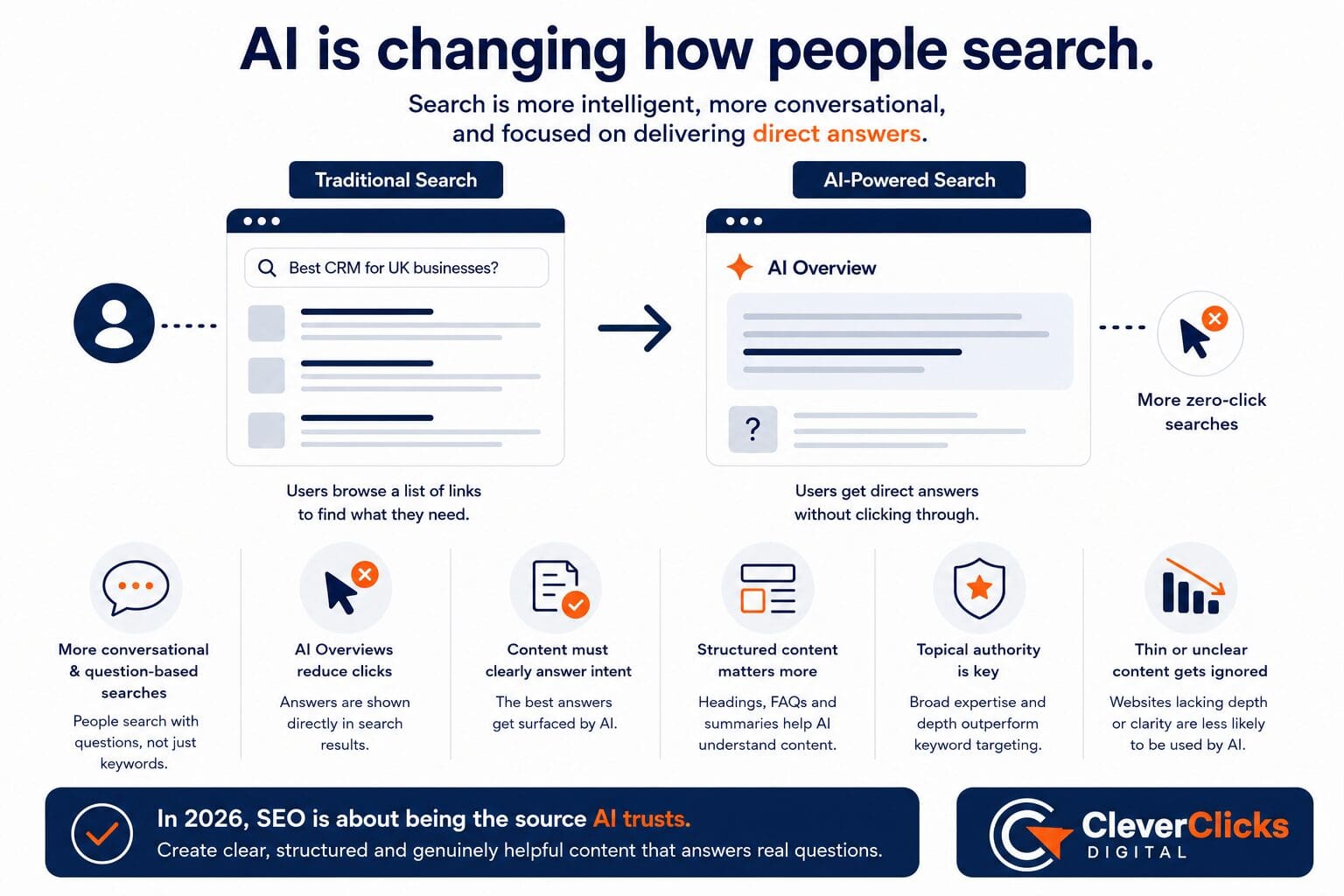
AI is fundamentally changing how search works in the UK. Instead of relying on keyword-based rankings, search engines now focus on understanding intent, context, and meaning. This means content is no longer just ranked by keywords, but by how well it answers a user’s question.
As AI becomes more integrated into search engines through tools like Google’s AI Overviews, users are increasingly given direct answers rather than a list of website links. This is leading to more “zero-click” searches, where users get what they need without visiting a website.
For UK businesses, this means SEO is no longer just about ranking position. It is about being selected as the source AI uses to generate answers.
Success now depends on creating content that is clear, structured, and genuinely helpful, rather than content designed purely for search engines.
As AI becomes more embedded in marketing activity, ethical considerations and regulatory compliance are becoming increasingly important. UK businesses must ensure that their use of AI aligns with data protection laws, emerging AI regulations, and growing consumer expectations around transparency and fairness.
Issues such as algorithmic bias, data privacy, and accountability for AI-generated content are no longer theoretical concerns; they are practical challenges that marketers must address proactively. Businesses that fail to consider the ethical implications of AI risk damaging trust, brand reputation, and long-term customer relationships.
Despite its rapid adoption, AI presents several challenges for UK organisations. Skills shortages remain a significant barrier, with many businesses struggling to recruit or train staff who can confidently manage AI-driven tools and interpret advanced data outputs. Cost can also be a factor, particularly for smaller businesses that lack the resources to invest in bespoke AI solutions.
Integration is another common issue, as legacy systems and fragmented marketing stacks can limit the effectiveness of AI technologies if not properly aligned.
To remain competitive, UK businesses should take a strategic and measured approach to AI adoption. This includes auditing existing tools, identifying where AI can deliver genuine value, and ensuring that teams are properly trained and supported.
Establishing clear governance frameworks, maintaining human oversight, and aligning AI usage with wider business goals will be essential. Businesses should also prepare for continued changes in search behaviour and customer expectations by focusing on content quality, user experience, and data-driven optimisation.
AI is undeniably reshaping digital marketing in the UK, offering unprecedented opportunities for efficiency, insight, and personalisation. However, the businesses that succeed in 2026 will be those that treat AI as a strategic enabler rather than a shortcut.
By combining AI-driven tools with human creativity, ethical responsibility, and long-term planning, UK organisations can build marketing strategies that are not only more effective, but also more resilient in an increasingly automated digital landscape.
Here at Clever Clicks Digital, we help UK businesses make sense of what actually matters. Get in touch for an honest conversation about where AI can (and can’t) improve your results.