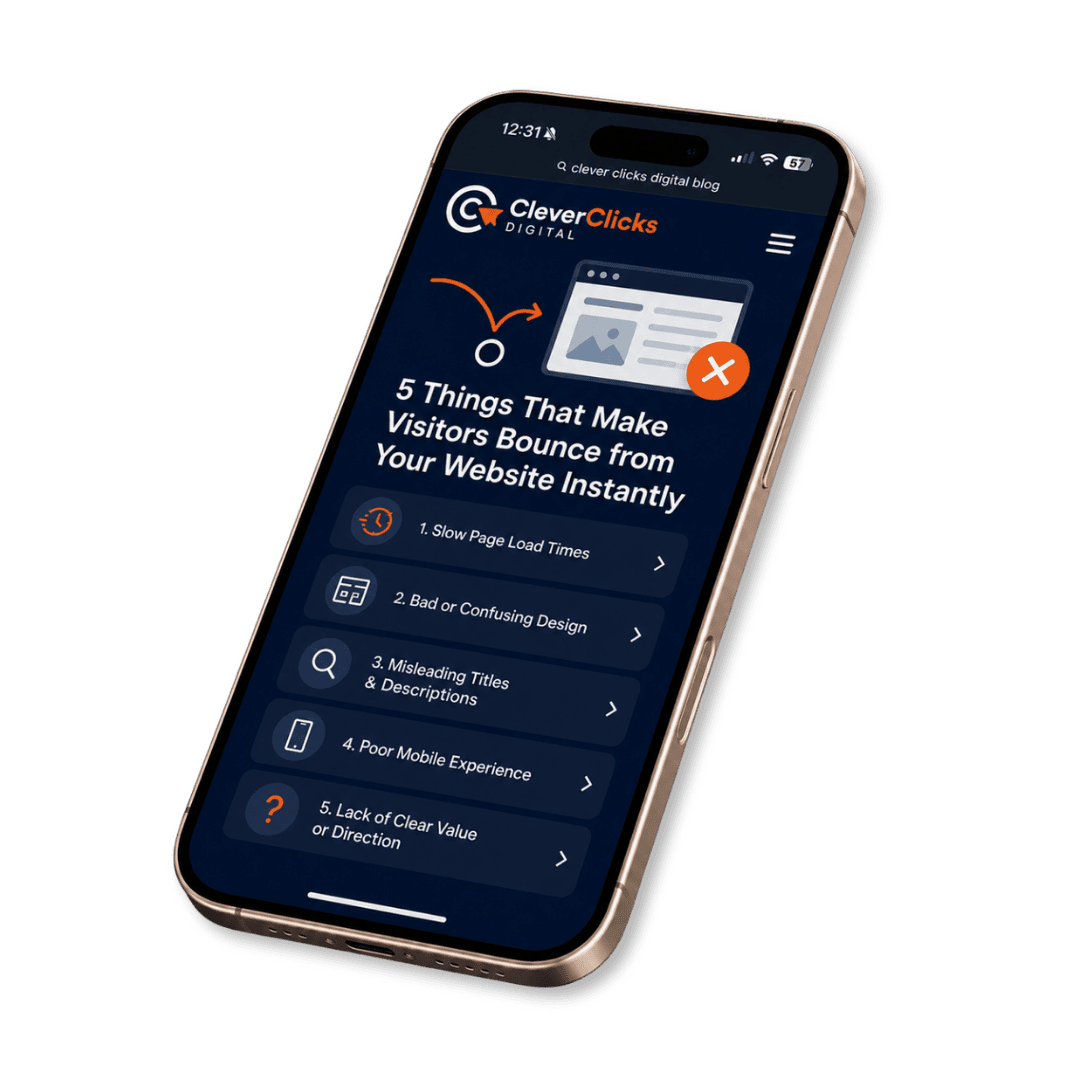
5 Things That Make Visitors Bounce from Your Website Instantly



Have you ever checked in on your analytics and wondered, Why are my visitors leaving my website so quickly? Well, you’re not alone, as a high bounce rate is quite common and frustrating for website owners. But what is bounce rate in a website?
Bounce rate refers to the percentage of visitors who land on a web page and leave without taking any further action. These actions can include clicking a link, visiting another page, filling out a form, and more. It is important to understand the causes of high bounce rates and what contributes to this frustrating metric.
While a higher bounce rate is not always a bad thing, for example, when a user quickly finds the information needed on a specific page such as a blog post. However, having a consistently high bounce rate on important landing pages, service pages, or ecommerce pages can indicate that there is something that is preventing visitors from engaging further. You must understand the difference, as it can help you focus on improvements that will genuinely impact conversions and the user experience.
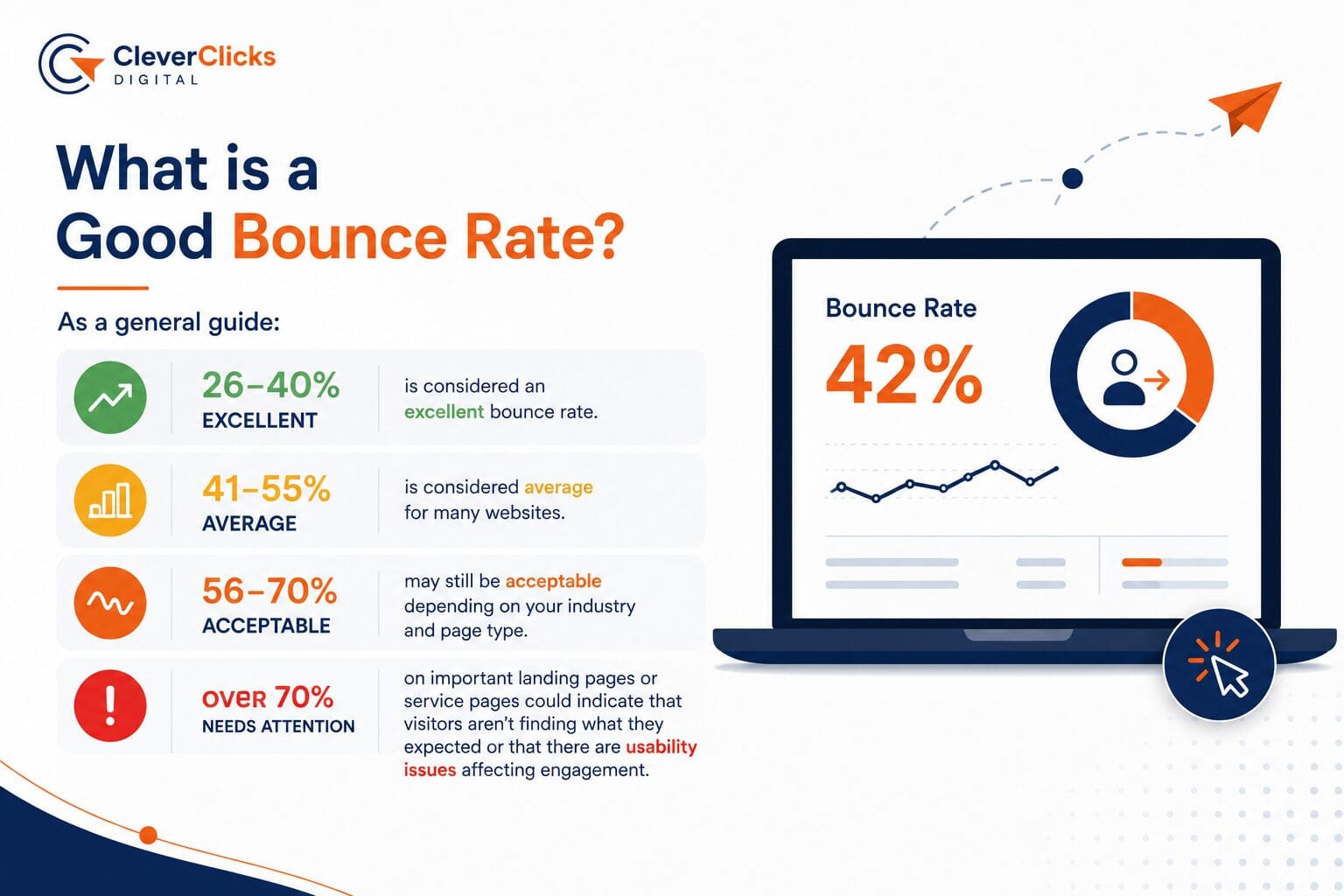
When it comes to bounce rates, there isn’t exactly a single “good” bounce rate that applies to all websites across the web. It depends on the type of website and the purpose of each page. An example of this could be a blog post or contact page that may naturally have a higher bounce rate if visitors quickly find the information they need and then leave. However, pages like service and product pages should generally encourage users to continue exploring your website or complete an action.
Rather than focusing solely on lowering your bounce rate, it’s more important to try to understand why visitors are leaving. You can do this by analysing user behaviour alongside other metrics, such as pages per session, conversion rate, and engagement time, to provide a much clearer picture.
People hate slow-loading webpages, and it is a major cause of high website bounce rates. This is particularly true for mobile users, as they are affected more due to slower connections and higher expectations. Even just a delay of 1-2 seconds of load time can cause bounce rates to increase by 103%, and if the page takes longer than 3 seconds, 53% of mobile visitors are likely to leave before it even loads (Huckabuy). This shows us that speed is a crucial trust signal in today’s digital environment.
To reduce bounce rates caused by slow page load times, you must optimise your website to be faster. This can be done through various ways, such as compressing images, minimising scripts per page, and using caching and content delivery networks 9CDNs). A faster website helps to keep visitors engaged and encourages deeper browsing.
A website design that is cluttered, chaotic and considered bad will drive users away quickly. Some common design issues can include too many pop-ups, bad or unclear navigation, excessive ads, clashing colours, bad fonts and more. These elements create a poor first impression with your audience and reduce engagement. Users prefer a website that has a clean, simple and distraction-free design.
Consider improving your website design to avoid bounce rates that are due to bad design, following a structured layout with readable content, clear navigation and well-placed calls to action. A good UX makes content a lot easier to digest and consume, encouraging users to stay on your website longer.
Your meta titles and descriptions must accurately represent the page they lead to; if the content doesn’t match what was promised in the search results, it can cause users to leave. If your titles or meta descriptions are misleading, vague or overly promotional, users may click through with expectations and leave when they find something else. The disconnect between expectation and reality can be a major contributor to high bounce rate issues.
The fix for this is easy: make sure your titles and descriptions are accurate, specific, and aligned with the actual content of the page. When users find exactly what they are looking for, they are much more likely to stay and engage, and it helps to build trust with your audience.
Your website must be optimised for mobile experience, as websites that don’t perform well on smartphones or tablets are likely to see a higher bounce rate. Nearly 59% of all global website traffic comes from mobile devices, and mobile users are 5 times more likely to abandon a site that isn’t mobile‑friendly (Fallingbrick). Text that is too small, broken layouts, clunky navigation, broken images, and a site that’s not fully responsive can frustrate users and are all signs of a poor mobile experience, causing users to leave before engaging with your content.
To prevent this, make sure your website is designed with mobile-optimisation in mind, making sure buttons are easy to tap, fonts readable, and key information accessible. A smooth, intuitive mobile experience can significantly reduce bounce rates.
This is one of the most overlooked high bounce rate causes; nearly 45% of landing page visitors leave without taking any action if your value proposition feels unclear or ambiguous (Growett). Visitors need to immediately recognise that they are in the right place, as without a clear value proposition, users will feel confused and likely leave the site. It is important to note that missing or vague calls to action can leave visitors unsure of what to do next. This issue is easily overlooked and common, but it causes high bounce rates.
To avoid this, make sure your homepage and landing pages clearly explain who you are as a company, what your offer is, whether that is services or products. Provide a clear next step with visible and effective call-to-actions, and concise copy that avoids jargon. Ensuring this type of clarity and guidance keeps users engaged and encourages deeper interaction.
To conclude, a high bounce rate does not always mean your website is underperforming, but it can help to highlight opportunities in which you can improve. For example, you could work on improving your website optimisation, user experience, and overall website engagement. By addressing common issues such as poor mobile optimisation, slow page speeds, confusing navigation, weak calls to action and content that doesn’t match search intent, you can create a better experience that encourages visitors to stay longer and take meaningful action.
Improving your website performance isn’t just about keeping users on your site; it is also about building trust, increasing user engagement, supporting a stronger conversion rate, and helping your website achieve much better visibility in search results. Regularly reviewing your site’s performance using tools such as Google Analytics, monitoring Core Web Vitals, strengthening your internal linking, and continually refining your landing page optimisation strategy can all contribute to long-term SEO success.
If you’re looking to reduce your bounce rate, improve your website usability, or optimise your website for both search engines and users, our team at Clever Clicks Digital can help. Get in touch to discover how our SEO, web design and digital marketing experts can help your business turn more website visitors into loyal customers.

How AI Is Changing Digital Marketing in the UK (And What to Do About It in 2026)
Read full blog
Discover whether TikTok ads or organic reach deliver better results for your brand. Learn where to invest your time and budget for maximum growth and ROI.
Read full blog